Yoruba art is the visual tradition of the Yoruba people, chiefly of southwestern Nigeria, Benin and Togo, and of a wide diaspora. It is widely studied, and widely borrowed.
What defines the Yoruba visual tradition?
Yoruba aesthetics prize ìwà (character) and balance. Figures tend to be frontal and composed. Proportion is symbolic: a larger head signals orí, a person's destiny and inner self. Colour is coded too. Indigo, white and red each carry associations with the òrìṣà and with social meaning.
What are the key symbols and motifs?
-
Adire: indigo resist-dyed cloth, patterned with starch or stitching.
-
Gèlèdé: a masking tradition that honours the power of women and elders.
-
Beaded regalia: crowns and staffs historically reserved for kings and priests.
-
Aso-oke: hand-woven strip cloth, worn for ceremony and status.
Many motifs refer to a story, a deity or a social role. That is why a motif out of context can read as decoration only.
How does Yoruba heritage show up in contemporary artworks?
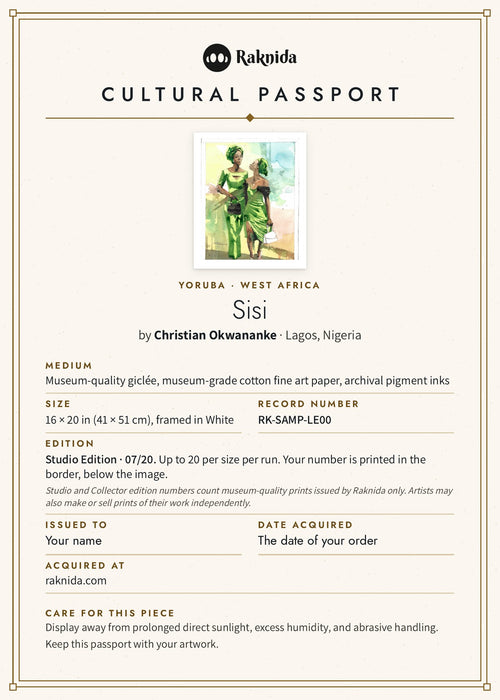
Today's artists reinterpret these languages. Some abstract adire grids into pattern. Others reframe mask imagery or carry beadwork rhythm into portraiture. Christian Okwananke's Sisi draws on aso ebi, the matching cloth friends and family wear to a celebration. The strongest work carries the meaning forward, not just the look.
How do you recognise it?
Look for the visual cues: a large, composed head, a frontal pose, indigo resist patterns, beaded regalia or the stripes of hand-woven cloth. Then ask what the work names.
A well-documented artwork says which tradition it draws on, which motif it uses and how the artist came to it. Working with a tradition you were not born into is normal. What matters is that the borrowing is named, not hidden.
On Raknida, that record is the work's Cultural Passport. Familiar motifs with no artist or story behind them tell you very little.
Explore Yoruba works on Raknida →